Summary
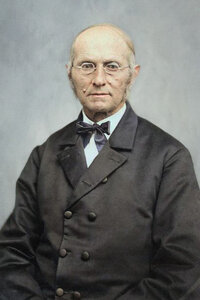
Samuel Sheffield Snow was a Millerite minister whose exposition of biblical prophecy, known as the “seventh-month message” or “true midnight cry,” gave rise in the summer of 1844 to the widespread expectation that Christ would return to earth on October 22, 1844. A former infidel converted through reading one of William Miller’s books, Snow developed the prophetic chronology that pinpointed the specific date by linking the Jewish ceremonial calendar to the 2,300-day prophecy of Daniel. His message, first preached with power at the Exeter, New Hampshire, camp meeting in August 1844, swept through the Millerite movement like a tidal wave and brought tens of thousands to a peak of spiritual readiness. Though Snow later departed from the body of Advent believers, the date he championed became foundational to Seventh-day Adventist theology.
Early Life
Samuel S. Snow was born in 1806 in Ashford, Connecticut, to Samuel (1774–1842) and Jerusha Robinson Snow (1780–1830). His ancestors were said to be “of Puritan stock.” He married Elvira M. Pound (b. 1805) on November 27, 1832, in Mansfield, Connecticut. Samuel and Elvira had four children who survived to adulthood: daughters Delia M. Rich (1836–1918), Frances Marion (1839–1871), and Mary Anne (1842–?); and son Theodore Sheffield Snow (1848–1916), who became a Baptist minister.
Little has been discovered about Snow’s education, but as a young man he rejected the Christianity he learned in his childhood and became, in his own words, a “hardened Infidel” and “a settled unbeliever in the Bible.” After the Boston Investigator, a weekly paper promoting freedom from the authority of religious dogma, was launched in 1831, Snow not only became an avid reader but an agent for its sale in Connecticut and did some writing for it. He regarded the Bible as “filled with nothing but gross absurdities” and read it only to find objections with which to challenge believers.
Conversion and Faith Journey
In 1839, Snow’s curiosity was aroused by one of William Miller’s books that a peddler sold to his brother. Snow had heard of Miller and his teaching about the near second advent of Christ and regarded the preacher’s views as “moonshine.” But as he read the book he became increasingly “impressed with its truth.” He came to see “that the Bible which I had so long rejected, was the word of God, and I melted down before it.”
He joined a Congregationalist church in the autumn of 1840 but some time later withdrew from it, finding it resistant to the Advent faith. In 1842, while attending the Millerite camp meeting in East Kingston, New Hampshire, he decided to give himself completely to promoting the Second Advent message. In December 1843 he received ordination to gospel ministry at an Adventist meeting.
Early Ministry
Snow did not become a prominent figure in the Millerite movement until the summer of 1844, after what is sometimes called “the Spring disappointment.” He had, however, been active in the movement for some time. As early as February 22, 1844, Snow published arguments in The Midnight Cry declaring, “The Lord has shown me… that we must wait and suffer a little longer.” His conviction was greatly strengthened when the earlier spring date passed uneventfully. He continued pressing his case in correspondence with The Midnight Cry on May 2, June 27, August 22, and September 19, 1844.
Snow’s conviction was clear: “I believe that as certain as the Bible is God’s truth, that just so certain the next event will be the coming of the Lord Jesus Christ.”
The “True Midnight Cry”
From the beginning of his preaching career, William Miller had contended that Christ would return “about the year 1843” in fulfillment of the 2,300-day prophecy of Daniel 8:14. As the time grew near, he took the position that Christ would return by March 21, 1844, the end of the Jewish year. Because Miller had allowed in advance for the possibility of miscalculation, the passing of this date without Christ’s return, while deflating, did not cause widespread loss of faith.
In August 1844, Snow issued a new paper entitled the True Midnight Cry and in its first issue, dated August 22, 1844, set forth his case that Christ would return in the autumn of 1844. Snow focused on the celebration feasts in the annual Jewish cycle as types of the saving work of Christ. He pointed out that Christ, the antitype, had fulfilled the springtime feast days at the very time of their occurrence in the Jewish calendar — Passover (crucifixion), First Fruits (ascension), and Pentecost (the outpouring of the Holy Spirit on the apostles). “God is an exact time keeper,” Snow declared. Thus, he reasoned that Christ would fulfill the work of the high priest on the Day of Atonement on the date of its occurrence in the Jewish calendar, that is, in the autumn, on the “tenth day of the seventh month” (Leviticus 16:29).
To establish the year in which this would take place, Snow calculated that the decree “to restore and build Jerusalem” (Daniel 9:25) that marked the beginning of the period of 2,300 days (symbolic years) given in Daniel 8:14 would have been issued in the latter part of the year 457 B.C. The 2,300-year period thus would end in late 1844, when the Day of Atonement (Yom Kippur) occurred that year. Based on the calendar of the Karaite Jews, Snow concluded that the Day of Atonement in 1844 would fall on October 22.
William Miller had suggested a similar line of interpretation more than a year before in a letter to Joshua V. Himes that was published in the Signs of the Times, May 17, 1843. But Miller had offered it only as a tentative possibility and it received little further discussion.
The Exeter Camp Meeting
Snow’s great breakthrough came at the camp meeting at Exeter, New Hampshire, in August 1844. According to pioneer accounts, Elder Joseph Bates was preaching when Snow arrived. He shared his calculations with Mrs. John Couch, who then interrupted Bates’s sermon with the words: “Here is a man with a message from God. ‘Behold, the Bridegroom cometh, go out to meet Him!'” Snow then presented his prophetic chronology, showing to the entire satisfaction of that vast body of intelligent believers that the prophetic period would terminate in the fall. The next day he repeated his message “with still greater clearness and force… that the types pointed to the tenth day of the seventh month as the time for our great High Priest to come out of Heaven and bless his waiting people.”
Elder Bates declared that Snow’s message “worked like leaven throughout the whole camp.” When the meeting ended, “the granite hills of New Hampshire were ringing with the mighty cry, ‘Behold the Bridegroom cometh! Go ye out to meet him!'”
The “seventh-month message” or “true midnight cry” (Matthew 25:6) brought powerful new energy to the Second Advent movement. James White, who would become a Seventh-day Adventist co-founder, observed that the message of Christ’s return in October 1844 was attended by a “power almost irresistible.”
The vigorous support of George Storrs, a prominent Millerite leader, boosted dissemination of the new message. The foremost leaders, Miller and Himes, viewed the development with caution, but they too eventually embraced the message, and intense expectation focused on October 22, 1844.
William Miller himself was persuaded, writing: “I see a glory in the seventh month which I never saw before…. Let Brother Snow, Brother Storrs and others be blessed for their instrumentality in opening my eyes. I am almost home, Glory! Glory!! Glory!!!”
Ellen G. White later described the seventh-month movement: “Like a tidal wave the movement swept over the land. From city to city, from village to village, and into remote country places it went, until the waiting people of God were fully aroused…. Of all the great religious movements since the days of the apostles, none have been more free from human imperfection and the wiles of Satan than was that of the autumn of 1844.” (The Great Controversy, pp. 398–401.)
After 1844
After the Great Disappointment, Snow accepted the teaching of Apollos Hale and Joseph Turner that on October 22, 1844, Christ came as the bridegroom and entered the marriage banquet in heaven, at which time He would also receive His everlasting kingdom from the “Ancient of Days” as described in Daniel 7. This was called “bridegroom” or “shut door” teaching because its proponents held that the door of salvation had been shut to those who had rejected the “true midnight cry.”
Snow began publishing the Jubilee Standard in 1845, in which he fiercely denounced Adventist leaders who repudiated the seventh-month message after Christ did not appear on October 22.
Later in 1845, Snow declared himself to be Elijah the prophet, the messenger that would appear immediately prior to the advent of Jesus the King. His followers started a new periodical, The True Day Star, to spread the message. Snow went still further in 1848. He issued “A Proclamation to All People Nations, Tongues and Kings,” declaring himself to be Christ’s “Prime Minister” and “Premiere,” and demanding from all earthly rulers and heads of state “a full surrender of all power and authority, into my hands, on behalf of King Jesus the Coming One.” The nations would suffer catastrophic consequences such as war, famine, and pestilence should they fail to submit.
Subsequently, however, Snow’s prominence diminished. Until his death more than four decades later, he continued to pastor a small following that became known as the Church of Mount Zion and met in varying locales in New York City. He died in late July 1890 at his residence in Brooklyn and was buried in Greenwood Cemetery on July 30.
Key Quotes
Snow’s testimony of conversion: “I was a callous and hardened Infidel, and was so for years…. I took the book home and read it, and the more I read it the more was I impressed with its truth…. I saw the perfect harmony between Daniel and the Revelation…, that the Bible, which I had so long rejected, was the word of God.”
On the timing of Christ’s coming: “God is an exact time keeper.”
William Miller’s response to Snow’s message: “I see a glory in the seventh month which I never saw before…. Let Brother Snow, Brother Storrs and others be blessed for their instrumentality in opening my eyes. I am almost home, Glory! Glory!! Glory!!!”
Ellen G. White on the midnight cry: “Like a tidal wave the movement swept over the land. From city to city, from village to village, and into remote country places it went, until the waiting people of God were fully aroused…. Of all the great religious movements since the days of the apostles, none have been more free from human imperfection and the wiles of Satan than was that of the autumn of 1844.” — The Great Controversy, pp. 398–401.
Legacy
Samuel S. Snow’s broader and enduring legacy for Seventh-day Adventists is the biblical exposition he championed that delineated October 22, 1844, as the date for the fulfillment of the prophecy of Daniel 8:14 in conjunction with an antitypical Day of Atonement. In contrast to Snow, who believed the event was to be the literal return of Christ, Seventh-day Adventists would come to hold that the date marked the beginning of a new and final phase of Christ’s work as High Priest in the heavenly sanctuary — a work involving a pre-advent judgment.
Snow’s prophetic chronology identifying October 22, 1844, proved to be correct, though the event the Millerites expected was not what occurred. The “midnight cry” that Snow proclaimed remains significant in Adventist understanding. Ellen White described it as a light set up behind the Advent people at the beginning of the path, which “shone all along the path and gave light for their feet so that they might not stumble.”
From Samuel Snow’s life we can understand that God may use a man to present actual truth, but that fact alone will not preserve him from error. Nevertheless, the message he carried — the midnight cry — was confirmed as being of divine origin, and its light continues to illuminate the path of Advent believers.